Family Made In Oley, PA



 Agriculture
 Industrial
 Sports and events
 Shops and garages

Offices and workspaces are not where most people picture an HVLS fan. These are usually associated with warehouses, barns, and factories—big, loud, industrial buildings. But modern open-plan offices, co-working spaces, retail backrooms, and creative studios have more in common with those spaces than people think. High ceilings, open layouts, inconsistent airflow, and people spending eight-plus hours a day in the space. HVLS fans fit into these environments more naturally than you’d expect.
Why Offices Have Airflow Problems
The move toward open floor plans has created a lot of large, high-ceilinged workspaces. Converted warehouses, brick-and-beam offices, co-working spaces in old industrial buildings, and modern designs with 14-to-20-foot ceilings all share the same issue: HVAC alone doesn’t distribute air evenly across the space.
Vents push conditioned air out, but it doesn’t always reach every desk, every meeting area, every corner of the floor. Some zones feel comfortable while others feel stuffy. In winter, warm air collects at the ceiling while the floor stays cool. In summer, the AC has to work harder to compensate for uneven distribution.
That’s exactly what HVLS fans help with. They don’t cool the air—they move it so the HVAC can actually do its job.
The Noise Question
The first concern most office managers raise about adding a big fan is noise. In an open workspace where people are on calls, meeting, or trying to focus, a loud fan isn’t an option.
This is where direct drive HVLS fans have an advantage. Without a gearbox, there’s less mechanical noise. Running at the speeds typical for office use—moderate airflow for comfort, not maximum output—they’re quiet enough to run during meetings and calls without being disruptive. People notice the comfort improvement without noticing the fan itself.
Energy Savings in Office Buildings
Running HVAC harder to compensate for poor air distribution is expensive. In buildings with high ceilings or large open floors, cooling and heating costs can be significantly higher than they need to be because the system is fighting against physics—warm air rising, cool air pooling, stagnant zones forming.
An HVLS fan running at low speed distributes conditioned air across the floor, which lets the HVAC run less to achieve the same comfort level. In winter, pushing warm air down from the ceiling reduces heating demand. In summer, the airflow lets the thermostat run a few degrees higher without anyone noticing a difference in comfort.
Across a year, those savings add up.
Aesthetics Count
Unlike a warehouse fan, an office fan is going to be seen by employees, clients, and visitors every day. That means the fan needs to look like it belongs in the space, not like it was borrowed from a factory.
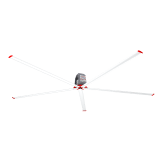
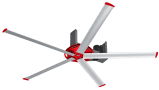
Modern HVLS fans come in finishes and colors that work in professional environments. Clean lines, matte finishes, and color options that match a design palette make the fan part of the space rather than an eyesore. In well-designed offices, a large overhead fan can actually enhance the industrial-modern aesthetic rather than clash with it.
Where They Fit Best
HVLS fans work best in office spaces with high ceilings and open floor plans. Co-working spaces, converted warehouses, large open-plan offices, creative studios, retail stores with high ceilings, and showrooms are all natural fits. Spaces with low ceilings and small rooms are less suited—traditional ceiling fans or ductless systems make more sense there.
For hybrid workspaces that combine open areas with meeting rooms and private offices, the fan goes in the open area while the smaller rooms handle their own airflow needs.
Sized for the Workspace
Office installations typically call for smaller HVLS fans than industrial spaces—8-to-14-foot diameters are common. The goal is comfort and air distribution, not maximum airflow. Oversized fans in office settings can create too much air movement, which is distracting even if it’s not loud.
AmeriWind works with office and workspace projects to size fans for the actual environment, so the result improves comfort without becoming a presence people have to work around.