
Manufacturing plants aren’t easy buildings to keep comfortable. Heat from equipment, dust and particulates in the air, high ceilings, and people working long shifts on their feet all add up to an environment where airflow really matters. Most plants already have some kind of ventilation system in place, but adding HVLS fans to the picture often changes how the floor actually feels to work in.
Why Standard Ventilation Falls Short
Most factories have exhaust fans, HVAC, or wall-mounted units handling the bulk of the air movement. The problem is that those systems are usually designed to exchange air—not distribute it. They pull air out or push air in, but they don’t necessarily move it across the floor where people are working.
The result is uneven conditions. One section of the plant feels comfortable. Another section feels hot, stuffy, or full of fumes. The HVAC system is running, but the air just isn’t reaching every part of the building evenly.
What HVLS Fans Add to the Picture
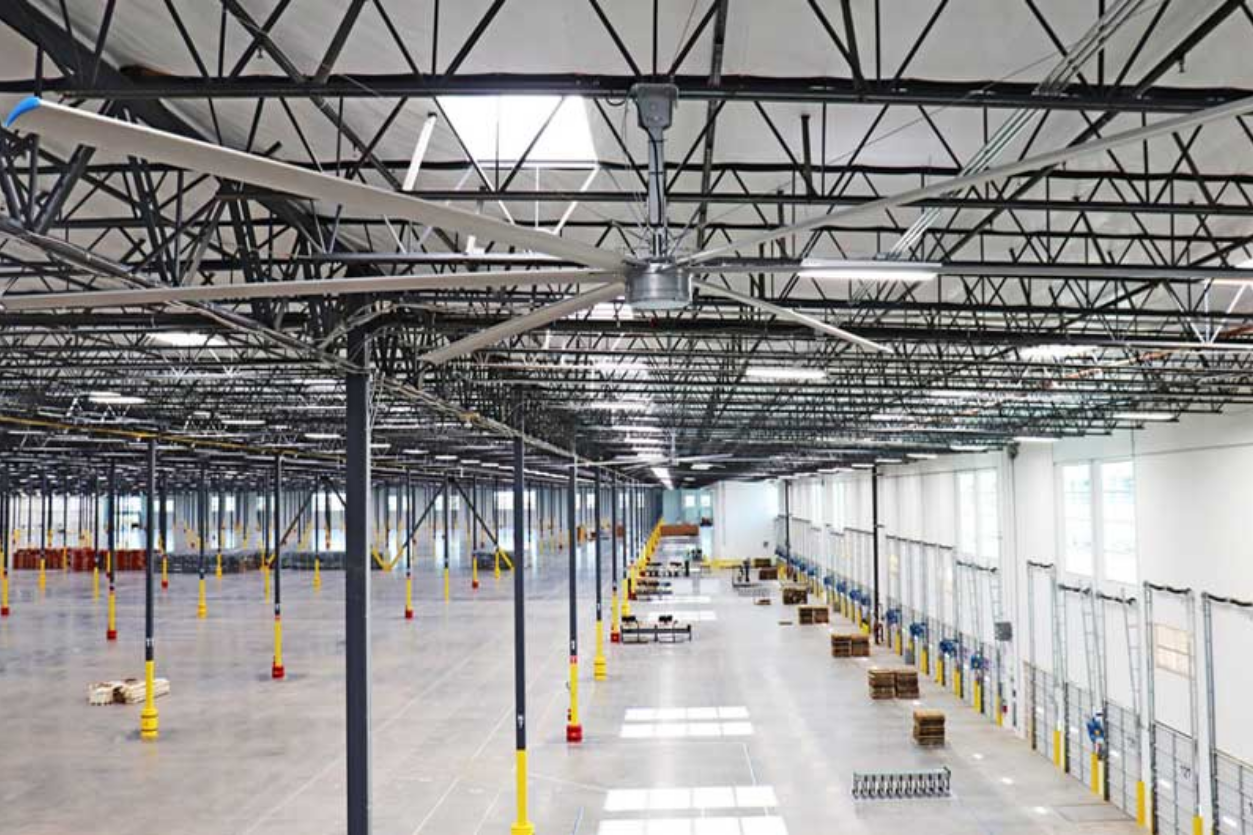
HVLS fans work alongside existing ventilation rather than replacing it. Their job is to move large volumes of air across the floor at slow, steady speeds. That keeps the air mixed, prevents stagnant zones from forming, and helps the HVAC system actually do its job by distributing the conditioned air it’s producing.
In a factory, that shows up in a few specific ways. The floor feels more uniformly comfortable. Heat from equipment doesn’t pile up in pockets. Dust and airborne particulates don’t settle into the same spots day after day. And the people working in the building feel the difference, especially during long shifts.
Heat Management Around Equipment
Manufacturing equipment generates heat. A lot of it. Furnaces, presses, welding stations, compressors, and assembly lines all add to the thermal load of the building. Without consistent airflow, that heat collects in specific zones and stays there.
HVLS fans help break up those heat pockets. By keeping air moving across the floor, hot zones don’t get the chance to stagnate. That improves worker comfort in the hottest parts of the plant and can also reduce stress on temperature-sensitive equipment. In facilities with electronics or precision machinery, consistent air temperature is part of keeping operations stable.
Air Quality on the Floor
Factories produce all kinds of airborne particles—dust, fumes, mist, vapors—depending on what’s being made. Even with proper exhaust systems, some of that ends up suspended in the air. When air doesn’t move, those particles settle into pockets near workstations.
Moving air doesn’t eliminate the particles, but it keeps them from concentrating in the same areas. Combined with the plant’s exhaust and filtration systems, HVLS fans help maintain a cleaner, more breathable environment across the floor.
Year-Round Use, Not Just Summer
A lot of plants think of HVLS fans as a summer solution, but they earn their keep in winter too. By pushing warm air down from the ceiling, they help even out temperature stratification—the warm air that naturally collects at the top of tall buildings. That makes the floor feel warmer without running the heating system harder, which often cuts heating costs over the season.
For industrial facilities running year-round, the ability to use the same fan for cooling in summer and de-stratification in winter is part of what makes the investment work.
Sized for the Plant
Factory floors vary widely—ceiling height, equipment layout, racking, and floor traffic all affect how fans should be placed. A plant with 20-foot ceilings and open floor space needs a different layout than one with overhead cranes and heavy machinery.
AmeriWind works with manufacturing facilities to design fan layouts around the actual plant. Sharing floor dimensions, ceiling height, and major equipment locations is the easiest way to get a layout that fits how the building actually runs.