HVLS Barn Ceiling Fans for Livestock
Cool the Herd - Barn Fans That Work
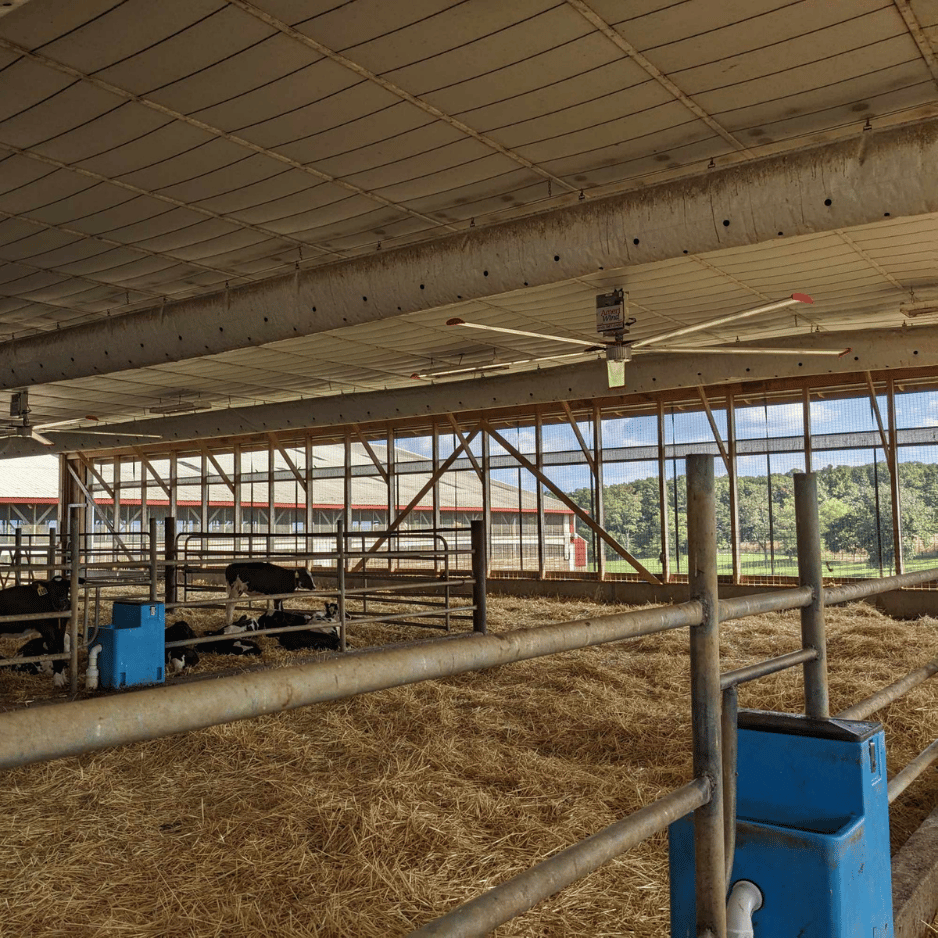
Proper air flow is beneficial for the comfort and productivity of livestock. This is why our efficient HVLS Barn ceiling fans keep livestock more comfortable while saving on your electricity bills.
Ameriwind Fan Features

Key features :
- Low maintenance
- Efficient design
- Strongest airfoils on the market
- Works for summer and winter
- Variable Speed Control
- Saves Electric
- Mounts easily in most building types
Barn Fan Benefits

Key features :
- Better performance – comfortable animals perform better.
- Cleaner livestock from drier bedding.
- Save bedding. Bedded pack areas reported 75% less bedding is needed.
- Works for summer and winter.
- Low electric bills. Slower RPMs in cooler weather dramatically cut electric loss.
Why AmeriWind fans are perfect for barns
🐄
Tailored
AmeriWind fans are engineered specifically for barns, pushing air low across bedding where animals need it most. Built by farmers, for farmers.
🇺🇸
Local
Family-owned in Pennsylvania, built and supported for real farmers.
🛡️
Durable
Direct-drive motors mean no gearboxes, no grinding, and no roar, just reliable airflow with sealed components built for dust, moisture, and nonstop use.
💡
Simple
No overpriced controllers, all of our fans come with farmer-friendly systems at a fraction of the cost of leading competitors.
😀
Service
Direct support from people who build and know barn fans, not call centers.
Is a barn ceiling fan right for you?
Industrial Barn Fans
Barns can get hot, stuffy, and damp, creating an uncomfortable environment for both animals and people. That’s where barn ceiling fans come in. These oversized fans gently move massive amounts of air, helping to keep your barn cooler, drier, and more energy efficient.
AmeriWind’s barn fans are designed to eliminate hot spots, reduce excess moisture, and improve airflow throughout your space. Whether you’re housing livestock, storing feed, or working in the barn yourself, better ventilation means healthier animals, longer-lasting bedding, and a more comfortable work environment.
Our Fans
HVLS big fan
recommendations
Large commercial warehouses and production facilities first used high-volume, low-speed (HVLS) fans. After that, HVLS fans were tested in dairy barns and found to be useful for raising cow comfort levels.
Many farms have high-volume, low-speed (HVLS) ceiling fans installed in their compost-bedded pack barns, and they appear to perform effectively. When installing fans, ensure adequate clearance underneath for tillage equipment to work at maximum pack depth and that the fan blades have bumper guards if close to the barn trusses. Most compost-bedded pack barns incorporate sprinklers with panel fans over the feed bunk for evaporative cooling and have fans over the pack area.
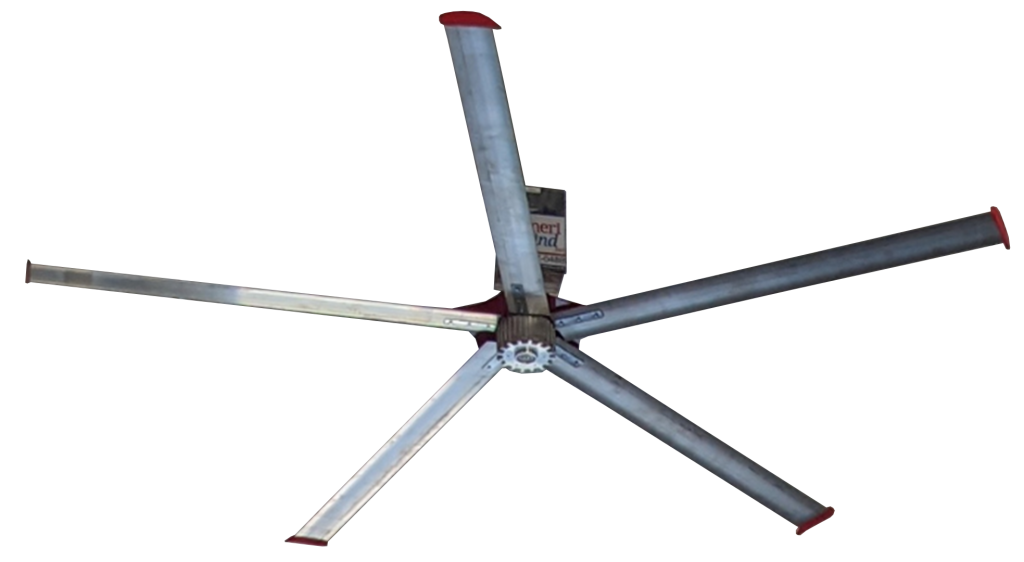
HVLS fans should be spaced at least 2-2.5 times their diameter. A 20-foot HVLS fan, for example, will span 40-50 feet horizontally and vertically. Some manufacturers may prescribe spacing at 3-4 times the diameter. These recommendations must be revised because they focus on human comfort rather than optimal cow comfort. AmeriWind normally recommends 2 times fan diameter for lactating and dry cows. Heifers, calves, and small animal applications can have the fans spaced at 3x fan diameter.
Regardless of the type of fans chosen, spacing is vital to minimize dead spots. The purpose of fans is to achieve air flows of 400-600 feet per minute (5-7 miles per hour) at cow level. HVLS fans have the advantage of covering a bigger area per fan, being more energy efficient, and being able to run at lower speeds during the winter. Even at top speed, they may only achieve the bottom limit of the needed air speed to cool cows. On the other hand, panel fans readily achieve the recommended airspeeds - but the side-to-side spacing required for equal air dispersion necessitates a large number of panel fans.
Running the HVLS fan in forward or reverse, changes the outcome. When running forward, it generates a column of air that is directly the same size as the fan diameter and emits a 360-degree wave of air out from the fan that is about 4 feet high. The air travels over the animals, cooling them because the fans are up to 30 feet in diameter.
Reversing HVLS fans can be done to force air upward during cold weather. This will destratify any heat that is stacked along the ceiling and gently circulate it throughout the facility.
Reversing is the easiest with variable-speed control. Maintaining the fan at about 20%. Using a natural ventilation system in reverse adds the advantage of moving air over the sidewall curtain fabric. This lowers the chances of moisture accumulation during cold weather.
HVLS fans run automatically with temperature controllers. The variable speed operation allows use in hot or cooler temperatures. The fans start at a low temperature and adjust their speed as the building warms. This is particularly useful in the spring and fall when there is a significant 24-hour variation in the outside temperature.
Compared to small high-speed fans, the operating cost of HVLS fans will be reduced. Because they cover a bigger area and use a variable motor. Local electricity authorities are encouraging the purchase of HVLS fans in various parts of North America by providing sizable discounts.
Birds are less inclined to enter the barn since they can see the slow-moving blades. However, birds can continue to roost and nest if perch points are made where the fans are installed.
The fan blades should be higher than the sidewall curtain openings in freestall dairy barns. The blade may bend under windy circumstances. This is why we developed the FanChief to turn off the fans when windy. The diameter of HVLS fans normally ranges from 8 feet to 24 feet, with the smaller models proving to be more resilient to wind damage.
When placing fans within a barn, keep in mind that cows will often concentrate in locations like scraping alleyways where the air is coolest, making it difficult for them to move around and cause obstructions.
Avoid putting a fan just under a light fixture. It can make a strobe light effect.
Speak with a ventilation consultant, simply by calling us. Get help determining the optimal configuration and size of HVLS fans for both you and your cows